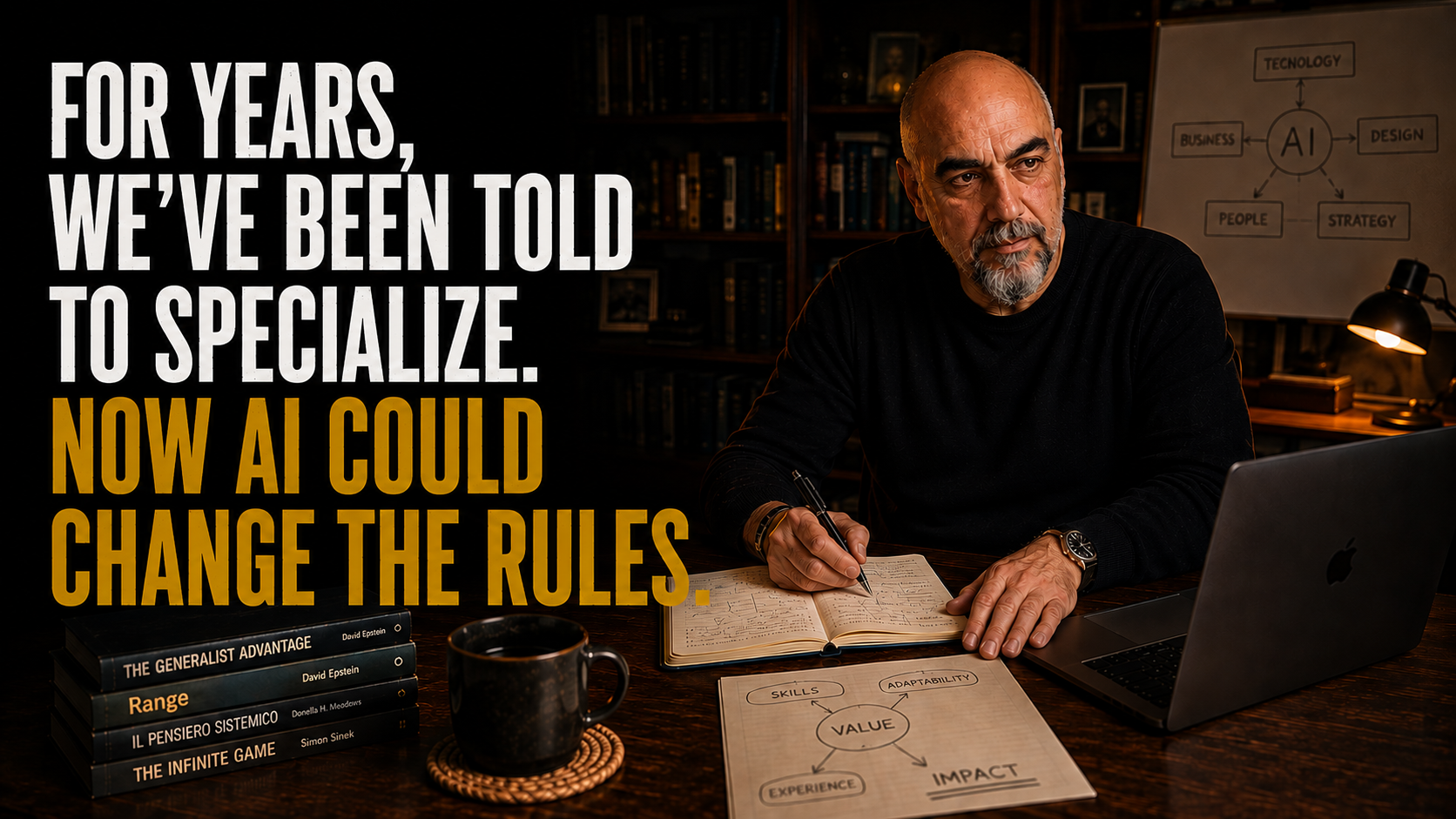
For most of my professional life, the advice I received was fairly simple: specialize.
The mantra was always something along the lines of: “Find something you’re good at, go deeper into it than everyone else, and build your value around it”. The more complex the market became, the more logical it seemed to divide work into increasingly specialized skills. The backend developer, the frontend developer, the database expert, the cybersecurity specialist, the designer, the data analyst, the project manager, the marketing specialist.
There was nothing wrong with this model. In fact, for a long time it worked extremely well.
But AI is introducing an interesting variable: it is dramatically reducing the cost of accessing, at least initially, expertise that used to be distributed across different people.
And that could change the relative value of generalists and specialists.
Not because specialists have suddenly become unnecessary. And certainly not because having ChatGPT in front of you somehow makes you competent in ten different disciplines.
The change is more subtle.
In the Past, Going Beyond Your Professional Domain Was Expensive, Sometimes Very Expensive
Think about a software developer fifteen years ago who needed to understand something outside their own field.
Need to design an interface? They would probably talk to a designer.
Need to interpret a contract? They would have to ask someone who knew the subject.
Need to prepare a marketing campaign, analyze a dataset, configure an unfamiliar server, or understand a particular regulation? The normal solution was to find someone with that specific expertise or invest time and money in acquiring it.
Not necessarily months. But enough to create a barrier.
Today, thanks to AI, that barrier has become much lower.
I can open almost any LLM and start with a software problem, discuss the architecture, move on to the database structure, ask it to explain a technology I don’t know very well, analyze a user interface, compare commercial approaches, and even prepare an initial economic analysis of the same project.
That still doesn’t mean I have suddenly become an expert DBA, UX designer, lawyer, marketer, and accountant.
It means something different: I can cross those boundaries much more easily.
And this is where the generalist starts becoming interesting.
The Generalist No Longer Needs to Know Everything
The caricature of the generalist has always been someone who knows a little about everything but nothing particularly well.
It is a legitimate criticism.
If I need a bridge designed, I don’t want someone who read a few things about civil engineering last week. If I need surgery, I’m not looking for an especially curious person with a good general understanding of medicine.
There will always be problems where depth of knowledge matters enormously.
But a huge amount of professional work does not consist of solving an isolated problem within a single discipline.
It consists of bringing different problems together. A software product is not just code: it has to solve a real problem, be usable, work with the existing infrastructure, comply with certain constraints, have sustainable costs, integrate with other systems, and produce something that someone is actually willing to use or buy.
In that context, the most important skill is not necessarily knowing more JavaScript than the best JavaScript developer in the company.
It is understanding enough JavaScript, enough architecture, enough product, enough business, and enough about the people who will use the system to see something that individual specialists, each looking at their own piece of the puzzle, might not see.
AI greatly expands this ability because it allows us to fill many of the gaps between one domain and another very quickly.
But There Is One Fundamental Condition: You Need to Know When AI Is Going Off Track
And this is where some of the enthusiasm around the idea that “AI democratizes expertise” starts becoming dangerous.
Having access to knowledge is not the same as having competence.
A model can explain a legal problem to me in an extremely convincing way. That doesn’t mean I have become a lawyer. It can suggest a software architecture that looks impeccable. If I don’t have enough experience to challenge that solution, I may end up implementing something completely wrong with a level of confidence I would never have had before.
Paradoxically, then, AI can produce two very different kinds of generalist.
The first is someone who already possesses a certain degree of professional depth and uses AI to extend their range.
The second is someone who lacks sufficient depth in any field and uses AI to simulate competence.
From the outside, they may look similar… until something goes wrong.
The difference is not the ability to obtain an answer. Today, that ability costs practically nothing.
The difference lies in the judgement required to understand whether that answer actually makes sense.
Perhaps Procedural Specialization Is What Is Really Under Pressure
This, in my view, is the most interesting point: I don’t believe AI is eliminating the value of specialists.
It may, however, reduce the value of a particular kind of specialization: one where much of the expertise consists of executing relatively well-defined procedures.
If someone’s value comes primarily from knowing a sequence of operations, AI is a formidable competitor.
If, on the other hand, their value comes from recognizing unusual situations, understanding consequences, forming hypotheses, contextualizing incomplete information, or knowing when a rule should not be applied, the situation changes considerably.
The distinction does not necessarily follow professional boundaries.
There may be an extremely specialized programmer whose work is highly procedural, and another developer working with exactly the same technology who has a very deep understanding of distributed systems and their failure modes.
Formally, both are specialists.
Their relationship with AI, however, could be completely different.
It is significant that even the most recent analyses of the future of work do not describe a world made up exclusively of increasingly narrow technical skills. The World Economic Forum’s Future of Jobs Report 2025 simultaneously lists AI and big data, technological literacy, analytical thinking, creative thinking, resilience, and flexibility among the skills increasing in importance.
That is not exactly the profile of someone confined to a single professional box.
McKinsey has also observed that, in its data, AI use at work increased from 30% of employees in 2023 to 76% in 2025, noting that the transformation affects not only the tools people use but also the content of their work and the way decisions are made.
It isn’t difficult to imagine what happens if this transformation continues.
Value Is Shifting From “Knowing How to Do” to “Knowing How to Orchestrate”
Take a fairly ordinary project: a company wants to automate the management of customer requests.
A few years ago, we might have divided the work among a business analyst, a developer, a database specialist, someone responsible for infrastructure, perhaps a UX designer, and a project manager.
Today, someone with sufficient cross-functional experience and the right AI tools can cover a surprisingly large part of that journey.
They can analyze the process, create a prototype, write code, configure APIs, prepare tests, generate documentation, and discuss requirements with the business.
When they encounter a genuinely specialized problem, they can still bring in a specialist.
The difference is that now they can identify much more easily where that specialist is actually needed.
For me, this is fundamental: the effective generalist does not necessarily replace specialists.
They reduce the number of times they need them and improve the quality of the questions they ask when they finally involve them.
Above all, they maintain an overall view that specialists, precisely because they are going deeper into different parts of the problem, can sometimes lose.
Perhaps the Old T-Shaped Model Is No Longer Enough
For years, we have used the concept of “T-shaped” skills.
A person has broad knowledge across many subjects, the horizontal bar of the T, and deep expertise in one particular area: the vertical bar.
It still seems like a good model.
The difference is that AI could dramatically widen that horizontal bar.
A developer with twenty years of experience doesn’t necessarily need to become a marketing expert to think seriously about go-to-market strategy.
A product manager doesn’t need to become a professional programmer to prototype something.
An entrepreneur doesn’t need to become a data scientist to explore their own data directly.
The depth remains.
But around that depth, a much larger operational surface begins to emerge.
Perhaps this is why the whole “generalist versus specialist” debate is framed incorrectly.
The interesting figure is not the generalist who isn’t particularly good at anything.
It is someone who possesses enough depth to have their own system of judgement and uses AI to continually expand the territory within which that judgement can be applied.
And This Creates a Problem for People Starting Their Careers Today
There is, however, a paradox that I can’t ignore: many of the people who can become effective generalists today built their depth before AI existed.
They spent years programming without Copilot, hunting bugs without asking an LLM, reading documentation, making architectural mistakes, putting systems into production, and discovering the consequences.
Now they can use AI as a multiplier because they already have something to multiply.
But what happens to someone entering the job market today who immediately delegates precisely those activities through which they would normally have developed that depth?
This is a very different problem from simply replacing jobs.
If we automate junior work, we may also automate part of the path that produces tomorrow’s senior specialists.
It is a concern that is increasingly emerging in discussions about the future of organizations: eliminating entry-level activities because they can be automated may have consequences for the way expertise is developed over time.
The problem therefore becomes almost circular.
To use AI well, you need experience.
But if we use AI to avoid the activities through which experience is acquired, where will that experience come from?
I Wouldn’t Choose Between Generalist and Specialist
If I had to advise someone at the beginning of their career today, I probably wouldn’t tell them either “specialize as much as possible” or “learn a little about everything”.
I would tell them something less comfortable:
Become really good at something.
Good enough to develop your own standard of judgement.
Then, perhaps, use AI to continually invade territories you previously couldn’t afford to explore.
Learn enough about those territories to understand how they connect to your own and, when you reach the limits of your competence, recognize them.
Because perhaps this is what AI is really changing.
For a long time, we assigned professional value partly according to the amount of knowledge a person could retain within their own domain.
Now we have machines capable of making an enormous amount of that knowledge available almost instantly.
Knowledge has not become useless.
It has become far more accessible.
And as a consequence, value tends to move elsewhere: toward the ability to formulate the right problem, connect information from different domains, distinguish a plausible answer from a correct one, and understand the consequences of a decision.
And perhaps, above all, toward knowing when we have reached the point where a generalist needs to stop asking questions to a machine and go looking for a real specialist.
Perhaps AI isn’t making generalists win over specialists after all.
It is simply making people who can be both far more valuable.